
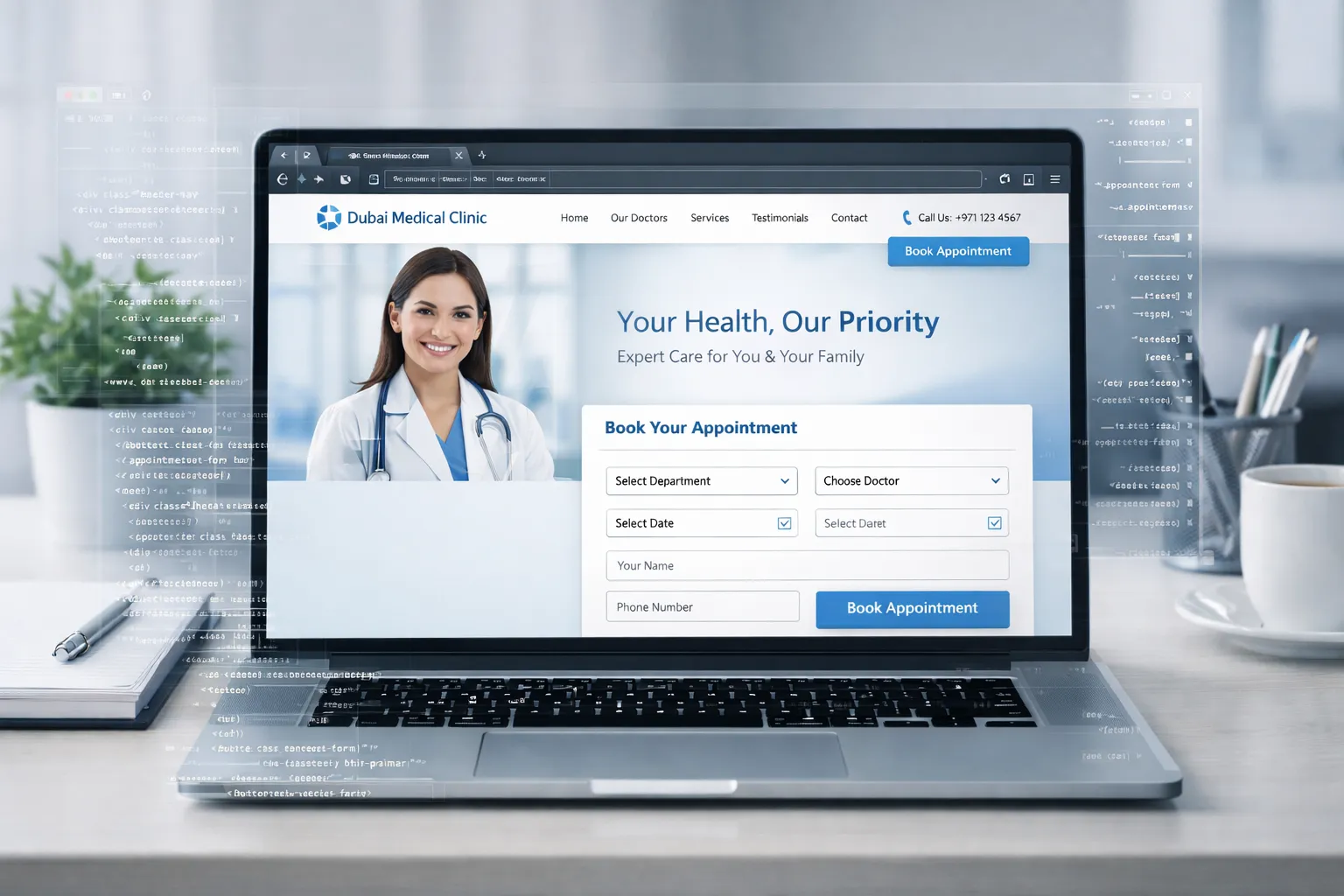
The Real Reason Your Clinic Website Gets Traffic But No Bookings
Most clinics think:
- More traffic = more appointments
- Better ranking = more patients
- New website = more leads
But healthcare conversion works differently.
Patients are cautious. They compare. The hesitate. They verify trust. If your website fails in any of these, they leave without booking.
Common hidden blockers:
- Poor medical UX
- No clear appointment CTA
- Weak trust signals
- Slow mobile experience
- Confusing booking flow
- No local credibility
- No urgency or reassurance
Let’s break each one down.
Problem 1 — Weak Medical UX Confuses Visitors
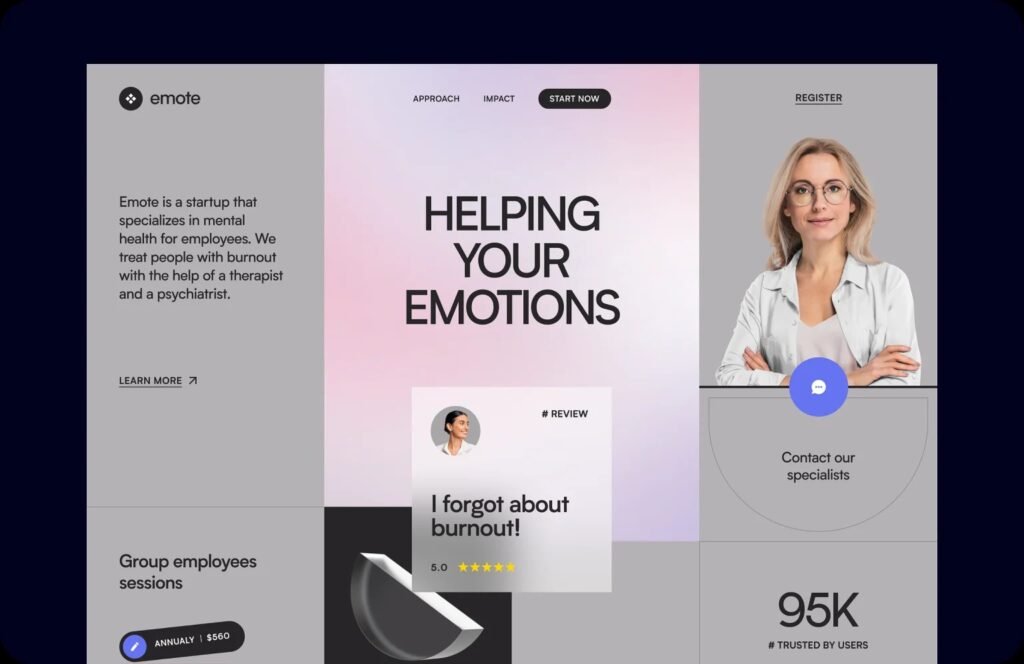
Medical UX is not like normal website UX.
Healthcare visitors are often:
- Anxious
- Time-sensitive
- Comparing providers
- Looking for reassurance
If your layout is cluttered or confusing, users leave.
Signs of Bad Medical UX
- Too many menu options
- Long scrolling without CTA
- Hard-to-find contact info
- Complicated forms
- Too many popups
- No visual booking path
Fix
- Show Book Appointment button above the fold
- Use simple navigation (Services / Doctors / Book / Contact)
- Reduce visual noise
- Add step-by-step booking flow
- Make forms short
Problem 2 — No Strong Appointment CTA
Many clinic websites hide the booking action.
That creates the “no appointments” issue on the clinic website.
Weak CTA Examples
- “Learn More”
- “Submit”
- “Continue”
- “Contact Us”
These are passive.
Strong Healthcare CTAs
- Book Your Appointment Now
- See Available Slots
- Schedule Visit Today
- Get Same-Day Consultation
- Talk to a Doctor Today
CTA Placement Rule
Put CTA:
- Top header
- After every service section
- Middle of page
- Bottom of page
- Sticky mobile button
Problem 3 — No Trust = No Booking
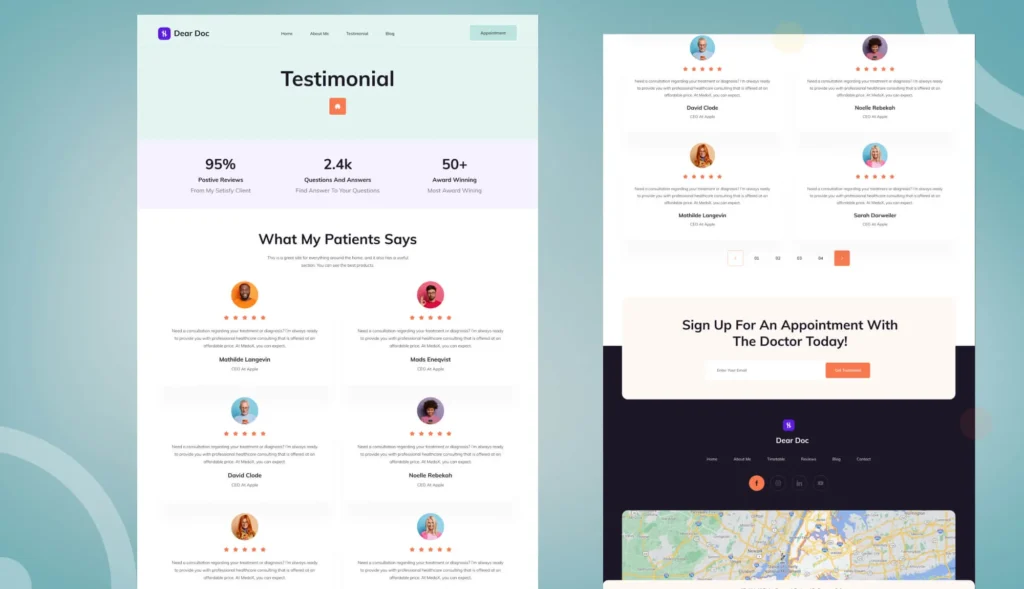
Healthcare decisions are based on trust.
If your site looks generic, users hesitate.
Missing Trust Signals
- No doctor profiles
- No credentials
- No certifications
- No patient reviews
- No before/after proof
- No clinic photos
- No real address proof
Add These Trust Builders
- Doctor experience cards
- License & certifications
- Google review widgets
- Real clinic photos
- Awards & affiliations
- Insurance partners
- Case success stats
Trust directly increases conversion.
Problem 4 — Slow Website Kills Medical Leads
Healthcare searches are often urgent.
If your site loads slowly:
Users bounce.
Speed Problems That Hurt Conversion
- Heavy images
- Poor hosting
- Too many scripts
- No caching
- Bad mobile optimization
Fix
- Compress images
- Use fast hosting
- Enable caching
- Optimize Core Web Vitals
- Reduce plugins
- Use lightweight themes
Speed = trust + urgency + conversion.
Problem 5 — Mobile Experience Is Broken
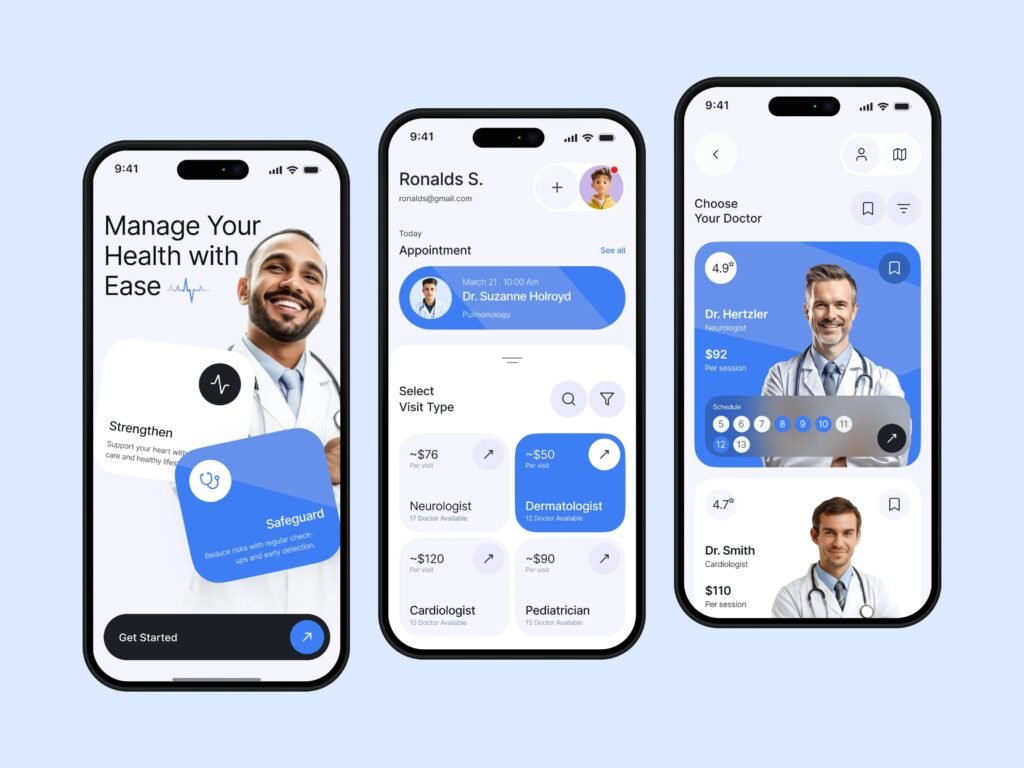
In Dubai, most healthcare searches happen on mobile.
If your mobile UX fails → clinic website has no appointments.
Mobile UX Mistakes
- Tiny buttons
- Long forms
- Text too small
- Booking button below scroll
- Hard calendar selection
Mobile Fix
- Big tap buttons
- 1-screen booking
- Autofill fields
- Click-to-call
- WhatsApp booking
- Mobile calendar picker
Problem 6 — No Local SEO Trust Signals
Local healthcare conversion needs local proof.
Users want:
- Nearby clinic
- Real location
- Area credibility
Missing Local Trust
- No map embed
- No location schema
- No Dubai mentions
- No area pages
- No local reviews
Fix
Add:
- Google map embed
- Area service pages
- Local testimonials
- Dubai clinic photos
- Neighborhood keywords
This improves both ranking and booking.
Download Clinic Website Conversion Checklist
Problem 7 — Booking Process Is Too Complex
Complex flow reduces healthcare conversion.
Bad Booking Flow
- Account required
- Too many steps
- Long forms
- Too many choices
- No instant confirmation
Best Practice Booking Flow
Step 1 — Choose service
Step 2 — Choose a doctor
Step 3 — Choose a slot
Step 4 — Confirm
That’s it.
Short = converts.
Problem 8 — No Emotional Reassurance Copy
Healthcare users need reassurance.
Generic text fails.
Weak Copy Example
“We provide quality services with expert doctors.”
Strong Copy Example
“Get same-day diagnosis from DHA-licensed doctors with 15+ years of experience.”
Specific beats generic.
Use:
- Experience numbers
- Success rates
- Safety language
- Care statements
- Guarantee language
Problem 9 — No Urgency = No Action
No urgency = no booking.
Add Urgency Elements
- Limited slots today
- Same-day booking available
- Weekend appointments open
- Fast results promise
- Priority consultation
Urgency nudges action.
Problem 10 — No Conversion Tracking
Many clinics don’t track behavior.
You can’t fix what you can’t measure.
Track:
- Booking clicks
- Form submissions
- Call clicks
- WhatsApp clicks
- Drop-off pages
Then optimize weak pages.
Conclusion
If your clinic website’s “no appointments” problem persists, the issue is not only traffic.
It is a conversion design.
Fix:
- Medical UX
- Trust signals
- CTA strength
- Mobile booking
- Speed Optimization
- Local proof
- Emotional reassurance
Healthcare websites must reduce fear and increase clarity.
Do that — and appointments follow.
Faqs
Because medical UX, trust signals, and CTAs are weak. Visitors don’t feel confident enough to book, even if traffic is coming.
Yes. Healthcare users need clarity and reassurance. Poor layout and confusing booking flows reduce appointment conversion significantly.
Very important. Patient reviews act as social proof and directly increase trust and booking likelihood for new visitors.
Yes. Short forms convert better. Only ask essential details first. Collect extra data later.
Yes. Most local healthcare searches happen on mobile. Poor mobile UX causes major appointment loss.
“Book Appointment Now” or “See Available Slots” performs best because it is direct and action-focused.
Yes. Local SEO builds nearby trust and visibility, which increases qualified visitors and booking intent.