

Many businesses invest heavily in blog content. They publish regularly. They rank on search engines. Traffic increases month after month.
But leads stay flat.
If you are facing the problem of blogs not converting into leads, the issue is not your effort — it is your conversion structure.
Most blogs are written to inform. Very few are written to convert.
There is a big difference between content that ranks and content that generates revenue. This guide will break down every major reason behind blogs not converting into leads and show you how to fix each one using smart content strategy, UX improvements, CTA systems, trust signals, and conversion design.
By the end, you will know exactly how to turn your blog into a lead generation asset instead of just a traffic source.
The Hidden Gap Between Traffic and Leads
Traffic does not automatically produce leads. That assumption causes most informational content issues.
Visitors come for answers. Leads happen when you guide decisions.
Most blogs stop at education. They do not continue into persuasion and action. That creates a conversion gap.
Common symptoms include:
- Strong keyword rankings but zero inquiries
- Long time on page, but no clicks
- Good impressions but low conversion rate
- Readers exit after finishingthe article
- No form submissions from blog pages
This pattern clearly shows that blogs not converting into leads is a conversion architecture problem, not a writing problem.
What Makes Conversion Content Different from Regular Content
Regular blog content focuses on:
- Explaining
- Teaching
- Informing
- Listing facts
Conversion content focuses on:
- Guiding decisions
- Reducing risk
- Building trust
- Showing outcomes
- Creating next steps
That difference changes everything.
A conversion blog is designed like a journey, not a textbook chapter.
The Most Common Informational Content Issues
Let’s go deep into informational content issues that block lead generation.
No Intent Matching
Many blogs target commercial keywords but deliver only educational answers. When reader’s intent is commercial, the content must include solution pathways.
No Problem Amplification
If you do not clearly show the cost of the problem, readers feel no urgency to act.
No Service Bridge
The article teaches, but never connects learning to your service offering.
No Proof Layer
Readers are not shown evidence that your method works.
No Next Step
There is no clear action suggestion.
These five issues alone explain most cases where blogs don’t convert to leads.
Content Strategy: The Foundation of Blog Conversion
Content strategy is not topic planning. It is conversion planning.
A high-performing content strategy answers:
- Who exactly is reading?
- What problem are they trying to solve?
- What risk are they facing?
- What solution do they need?
- Why should they trust you?
- What should they do next?
Without this framework, blogs that don’t convert to leads will continue, no matter how much you publish.
A conversion-focused content structure follows this flow:
Problem → Impact → Insight → Method → Proof → Offer → Action
Why Most Blogs Educate But Do Not Persuade
Education alone rarely converts.
Readers need:
- Clarity
- Confidence
- Safety
- Direction
Persuasion does not mean hype. It means reducing uncertainty.
You do this with:
- Specific examples
- Scenario explanations
- outcome descriptions
- process transparency
- measurable benefits
When persuasion is missing, informational content issues appear, and conversion drops.
UX Problems That Quietly Kill Lead Generation
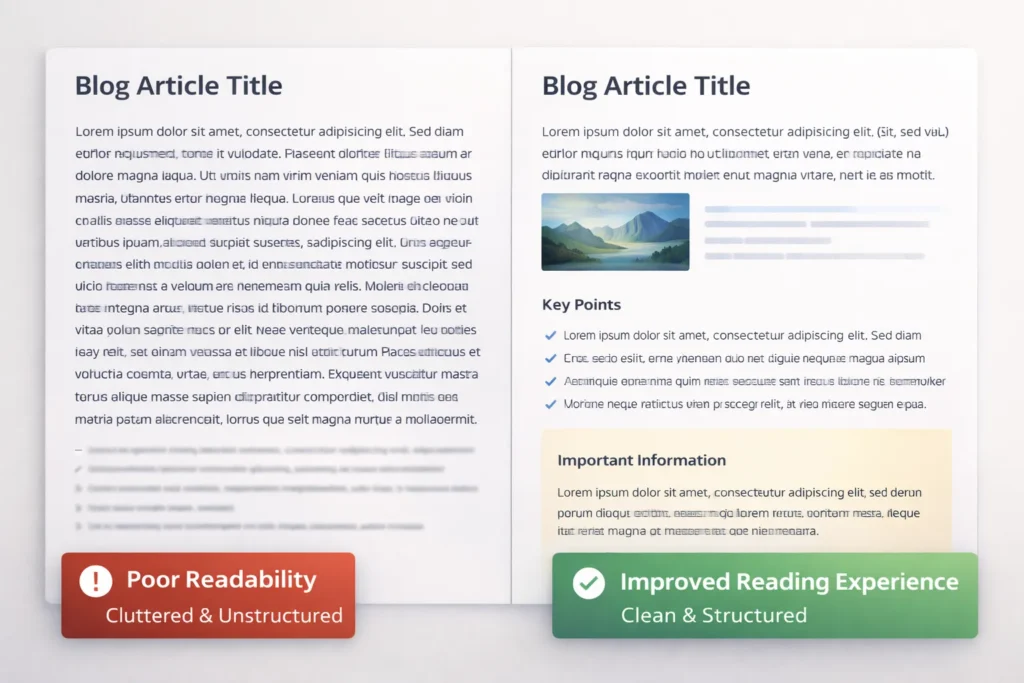
User experience strongly affects conversion behavior.
Even excellent content fails when the reading experience is poor.
UX mistakes that reduce blog conversions:
- Very long paragraphs
- No visual hierarchy
- No spacing
- No subheadings
- No emphasis formatting
- No summary boxes
- Hard mobile reading
- Weak typography contrast
Readers leave when reading feels heavy.
Better UX increases trust and engagement automatically.
CTA Systems — The Core Fix for Blogs Not Converting Into Leads
CTA is the most important conversion element inside blogs.
Many sites use only one CTA at the end. That is not enough.
Readers decide at different points. Your CTA must appear at multiple decision moments.
Types of blog CTAs that work:
Soft CTAs:
- Download checklist
- Read the case study
- View guide
Mid CTAs:
- Get audit
- Request review
- Try tool
Direct CTAs:
- Book consultation
- Get quote
- Talk to an expert
CTA text must be benefit-driven, not generic.
Bad: Submit
Good: Get My Conversion AudiTrust Signals — The Conversion Multiplier
Trust is what turns readers into clients.
Without trust, even perfect CTA placement fails.
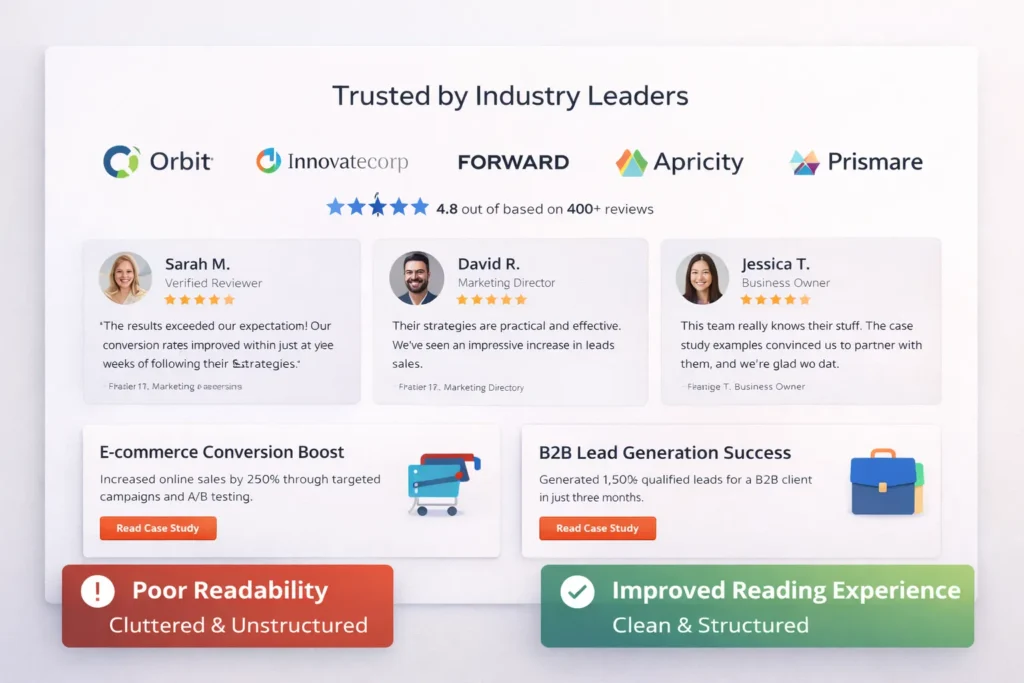
Add trust signals inside blog flow — not only on the homepage.
Download the Blog Conversion Checklist
High-impact trust signals:
- Mini case results
- Client outcome metrics
- Before/after numbers
- Expert quotes
- Process transparency
- Real screenshots
- Years of experience
- Method breakdown
- Tool stack disclosure
Trust removes fear. Removing fear increases leads.
This directly fixes blogs not converting into leads.
The Role of Design in Conversion Psychology
Design affects credibility perception.
Visitors judge quality in seconds.
Conversion-supporting design includes:
- Highlight insight boxes
- Key takeaway panels
- Problem warning blocks
- Result callouts
- Visual step flows
- Comparison tables
- Pull quotes
- Proof cards
Design guides attention. Attention guides action.
How to Insert Service Positioning Without Sounding Salesy
Many writers avoid mentioning services to avoid sounding promotional. That creates informational content issues.
You can position services naturally using problem-solution framing.
Example structure:
- Explain problem
- Show complexity
- Show the risk of DIY
- Present expert solution path
This feels helpful — not salesy.
Internal Linking for Lead Flow
Your required internal link target is: Industry Website Services
Place it inside the solution context — not randomly.
Example usage style inside blog body:
When businesses want faster results, they often use Industry Website Services focused on UX, conversion design, and CTA architecture.
Contextual linking improves both SEO Optimization and the conversion journey.
Lead Magnets That Convert Blog Readers
Lead magnets create value exchange.
Reader gives email → receives solution asset.
High-performing magnets:
- Audit checklist
- Strategy worksheet
- Mistake scanner
- Scorecard
- Template pack
- Cost estimator
- Optimization guide
Lead magnets solve blogs not converting into leads by capturing interest early.
Reader Journey Mapping — The Advanced Fix
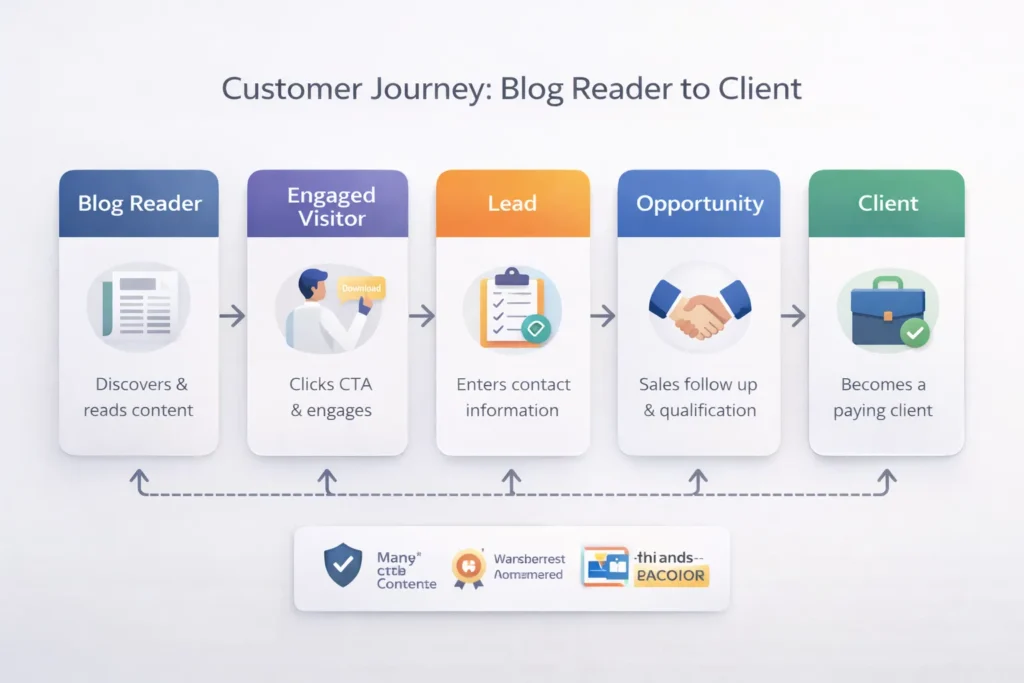
Advanced content strategy maps reader psychology stages:
Stage 1 — Awareness
Stage 2 — Concern
Stage 3 — Evaluation
Stage 4 — Trust
Stage 5 — Decision
Each section of your blog should move the reader one stage forward.
Most blogs stay stuck at awareness only.
That is why blogs not converting into leads remains common.
Conversion Copywriting Elements to Add
Add these inside your content:
- Risk statements
- Outcome statements
- Scenario visuals
- “Imagine if” framing
- Loss avoidance language
- Time savings framing
- Error cost framing
These increase motivation to act.
Why Long Blogs Still Fail Without Conversion Structure
Length helps ranking — not conversion.
A 3000-word article without:
- CTA
- trust
- UX
- offer bridge
…will still fail.
A structured article converts. A long article ranks.
You need both.
Conversion Checklist for Every Blog
Before publishing, confirm:
- Is reader’s intent matched?
- Is the problem clearly defined?
- Is the impact explained?
- Is solution mapped?
- Is the service positioned?
- Is proof included?
- Are CTAs placed?
- Is UX clean?
- Is trust visible?
- Is the next step obvious?
If yes — conversion probability rises sharply.
Conclusion
Blogs not converting into leads is not a mystery. It is a structural issue.
Fix informational content issues. Add conversion mapping. Improve UX. Place strategic CTAs. Build trust inside the content. Guide reader decisions.
When content strategy meets conversion design, blog traffic turns into real clients — consistently.
Faqs
Because traffic and conversion are different systems. Without CTA placement, trust signals, and intent matching, visitors read and leave without taking action.
Yes, when they include conversion strategy, service positioning, and reader journey mapping instead of pure education only.
At least three — mid content, after solution sections, and at the end — using different CTA strengths.
Yes. Clean layout, spacing, and structure improve reading comfort and trust, which directly increases action rates.
They are gaps where content informs but does not persuade, guide, or offer next steps.
For commercial intent topics, yes — through contextual internal links.
Only when structured for conversion. Length alone does not generate leads.