
B2B website development is different from consumer web development. B2B buyers research for months, evaluate multiple vendors, involve buying committees, and require trust-building before contracting. A B2B website that converts isn’t a beautiful brochure — it’s a structured set of pages that meets buyers at each stage of their journey, removes friction, and reduces perceived risk.
This guide explains what B2B website development actually requires in 2026: structure, content, technical foundations, and integration with sales and marketing operations. No generic claims — just the specific decisions that separate B2B websites that generate pipeline from B2B websites that look impressive but don’t.
How does B2B website development differ from consumer web development?
Five structural differences shape B2B web development:
1. Long sales cycles. B2B buyers take weeks to months to decide. The website needs to support every stage — awareness, research, comparison, evaluation, decision — not just drive immediate conversions.
2. Multiple decision-makers. The technical buyer cares about features and integration. The economic buyer cares about ROI and risk. The end user cares about ease of use. A B2B site must speak to all three.
3. Trust is the conversion bottleneck. Visitors won’t book a demo with a vendor they don’t trust. Trust signals (customer logos, case studies, certifications, named team members) drive B2B conversion more than design.
4. Content depth matters more than visual polish. B2B buyers research deeply. Long-form content (case studies, whitepapers, technical documentation, ROI calculators) converts better than glossy graphics alone.
5. Integration with sales and marketing operations. B2B websites need CRM integration, marketing automation, lead routing, attribution — the website is one component of a sales-marketing system, not a standalone asset.
What does a high-converting B2B website actually include?
Clear value proposition for specific audience
Above the fold: who you serve, what specific problem you solve, what concrete outcome you deliver. “Software for businesses” loses. “Inventory management software for multi-location retailers doing $5M–$50M” converts.
Case studies with specific outcomes
Real customer names, real metrics, real timeframes. “Reduced order fulfillment time 47% in 90 days for [Customer X]” beats “helps companies improve operations.” Generic case studies signal lack of real customers.
Detailed product/service pages
Feature explanations, use cases, integration details, security and compliance information, screenshots or demo videos. B2B buyers want to evaluate before talking to sales — give them the information.
Pricing transparency (or clear approach to pricing)
Even when prices are negotiated, the page should indicate price range, what factors affect cost, and how to get a quote. “Contact us for pricing” with no other information signals you’re hiding something.
Multiple conversion paths
Different visitors are at different stages. Provide: demo booking (high-intent), download (educational content), webinar (mid-funnel), contact form (specific questions), free trial (product-led), pricing inquiry (decision-stage). A single “Contact us” form leaves money on the table.
Trust and credibility signals
Customer logos in your target segment, SOC2/ISO/HIPAA badges where relevant, security details, real team page with photos and credentials, awards and analyst recognition, customer review aggregator badges (G2, Capterra).
Resource library
Blog content for SEO and education, whitepapers for lead gen, case studies for proof, webinars for engagement, ROI calculators for justification. B2B content compounds traffic over years.
What does B2B website development cost?
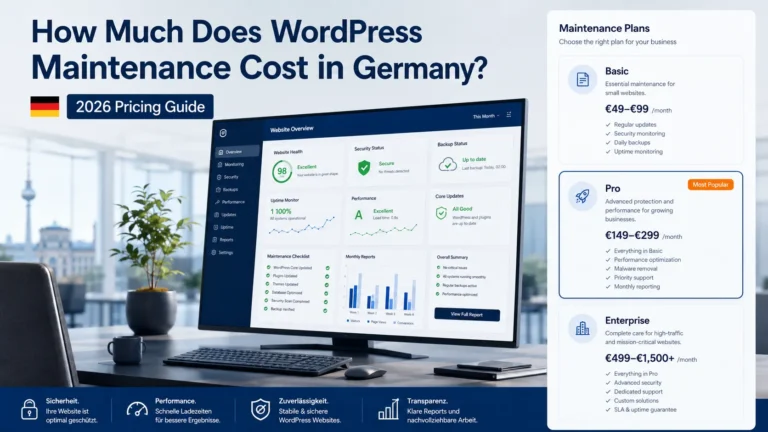
- Small B2B SaaS or services site: $15,000–$45,000
- Mid-market B2B website with custom design: $40,000–$120,000
- Enterprise B2B with multi-product, multi-region, complex integrations: $120,000–$500,000+
- Ongoing maintenance + content: $3,000–$15,000/month
The website is one line item. B2B marketing operations (CRM, marketing automation, sales enablement tools) add $30K–$200K/year. Budget for the full system, not just the website.
How does B2B website development integrate with sales and marketing?
Critical integrations:
- CRM integration (HubSpot, Salesforce, Pipedrive) — lead capture, lead scoring, lead routing
- Marketing automation — nurture sequences for downloads and webinar attendees
- Calendar booking (Calendly, Chili Piper, HubSpot Meetings) — friction-free demo booking
- Analytics + attribution — GA4 with server-side tracking, multi-touch attribution to understand which content drives pipeline
- Chat or AI assistant — capture intent visitors who don’t fill forms
- ABM integration (Demandbase, 6sense) for enterprise B2B
A B2B website disconnected from these systems delivers a fraction of its potential value.
What technical foundations matter for B2B websites?
- Core Web Vitals — affects both rankings and conversion
- Schema markup (Organization, Product/Service, FAQ, BreadcrumbList)
- Mobile-first responsive design — B2B buyers increasingly research on mobile
- Security — HTTPS, WAF, dependency updates; B2B buyers check security posture
- Accessibility — WCAG 2.2 AA, required by law in many jurisdictions; signals enterprise readiness
- Server-side tracking — essential for accurate attribution post-iOS 14.5
What integrates with B2B website development?
- Website development services
- SEO services — B2B SEO is content-led and slow but compounding
- Conversion rate optimization — B2B has lower conversion rates but higher per-conversion value
- Digital marketing — paid acquisition for B2B (LinkedIn, Google Ads) requires strong landing pages
Frequently asked questions about B2B website development
What is B2B website development?
Web development specifically structured for B2B buying behavior — long sales cycles, multiple decision-makers, trust-driven conversion, content depth, integration with sales/marketing operations. Different requirements than consumer e-commerce or simple lead-gen sites.
Why is B2B website development important?
B2B buyers do 60–80% of research before engaging sales. The website is the primary touchpoint during that research. A weak website loses the deal before sales gets involved. Strong B2B sites generate qualified pipeline and reduce sales cycle length.
How long does B2B website development take?
Small B2B site: 8–12 weeks. Mid-market with custom design: 14–20 weeks. Enterprise B2B with custom development and integrations: 24–40 weeks.
What features should a B2B website include?
Clear value proposition for specific audience, named case studies with metrics, detailed product/service pages, pricing transparency or pricing approach, multiple conversion paths, trust signals (customer logos, certifications, team), resource library for SEO and lead gen, CRM and marketing automation integration.
How does SEO help B2B websites?
B2B buyers research extensively before vendor engagement. SEO-driven content (blog posts, guides, case studies, calculators) captures research-stage visitors and builds trust. B2B SEO is slow but compounds — well-executed programs deliver 60%+ of marketing-sourced pipeline within 18–24 months.
Can B2B website development increase sales?
Yes, when integrated with marketing and sales operations. The website itself generates leads; the integrated system (website + CRM + nurture + sales process) converts those leads to revenue. The website alone is necessary but not sufficient.
How do I choose the best B2B website development partner?
Verify B2B specialization (not consumer e-commerce or simple lead gen experience), case studies with B2B clients in your category, integration experience with HubSpot/Salesforce or your CRM, post-launch CRO and ongoing support model, content production capacity for ongoing SEO.
Ready to talk about B2B website development?
B2B website development is one component of a sales-marketing system. The companies that compound pipeline build the website and the operations around it together — not as separate purchases stitched together later.
Book a meeting for a free B2B website strategy consultation — we’ll review your current site, audit conversion paths, identify trust gaps, and recommend a realistic scope for an integrated B2B web engagement. Or browse our website development services and contact us directly.