

Ecommerce hosting is not just a technical decision. It is a revenue decision. Many online stores fail not because of bad products, but because of weak Web hosting.
Slow pages. Checkout errors. Downtime. Security warnings. These small issues destroy trust and kill conversions.
If your ecommerce store loads slowly or crashes during traffic spikes, you are losing customers right now.
In this complete Web hosting guide, you will learn:
- Why ceommerce Web hosting matters for revenue
- Common hosting problems that hurt sales
- UX and checkout performance issues
- Hosting solutions that fix conversion leaks
- How to choose the best ecommerce Web hosting
- Performance and trust factors
- Real solutions that increase store success
Let’s break it down.
What Is Ecommerce Hosting?
Ecommerce Web hosting is a specialized web hosting service designed for online stores. It supports:
- High traffic loads
- Secure transactions
- Fast product page delivery
- Checkout reliability
- Payment gateway integration
- Database performance
- Cart and session handling
Normal web hosting is not enough for serious Ecommerce Web hosting stores.
Ecommerce web hosting must support speed, uptime, and security — all at once.
Why Ecommerce Web hosting Directly Impacts Sales

Many store owners invest in design and ads but ignore hosting performance.
Bad ecommerce Web hosting causes:
- Slow page load times
- Cart failures
- Checkout errors
- Payment timeouts
- Mobile lag
- Server crashes during sales
- Search ranking drops
Every second of delay reduces conversions.
Research shows:
- 1 second delay = up to 7% conversion loss
- Slow checkout = higher cart abandonment
- Server downtime = instant revenue loss
Ecommerce hosting performance = sales performance.
Common Ecommerce Web hosting Problems That Kill Conversions
Slow Page Speed
Slow-loading product pages frustrate users. Users leave before seeing the offer.
Causes:
- Shared servers
- Weak caching
- Poor server response time
- No CDN
- Heavy database queries
Solution:
- Optimized ecommerce hosting
- Server-side caching
- CDN integration
- NVMe storage
- LiteSpeed or optimized stack
Checkout Failures
Weak hosting causes:
- Checkout page reloads
- Payment errors
- Gateway timeout
- Session loss
Solution:
- Hosting with session stability
- Dedicated resources
- Database optimization
- Checkout page caching rules
Traffic Spike Crashes

During promotions or ads, traffic increases — but cheap hosting cannot handle the load.
Result:
- Site crashes
- Lost buyers
- Ad budget wasted
Solution:
- Scalable web hosting
- Auto-scaling servers
- Cloud infrastructure
- Load balancing
Security Warnings
Ecommerce stores must be secure. Hosting gaps cause:
- SSL issues
- Malware risk
- Trust badge errors
- Payment distrust
Solution:
- Managed Ecommerce Web hosting
- SSL auto-renewal
- WAF firewall
- Malware scanning
Trust = conversion fuel.
How Ecommerce Hosting Affects UX
User experience depends heavily on hosting performance.
Hosting impacts:
- Page load smoothness
- Image delivery speed
- Cart response time
- Search filters speed
- Mobile performance
- Checkout flow
Bad ecommerce = broken UX journey.
Good hosting = smooth shopping experience.

How Hosting Impacts CTA Performance
Your call-to-action buttons must respond instantly.
Slow hosting causes:
- Add to cart lag
- Button delay
- Cart update freeze
- Coupon application errors
When the CTA response is slow, users think the site is broken.
Fast ecommerce Web hosting improves CTA responsiveness and increases conversions.
Hosting & Ecommerce Design Performance
Modern ecommerce design includes:
- High-resolution images
- Animations
- Dynamic filters
- Live search
- Recommendations
- Reviews widgets
These features require strong Web hosting performance.
Weak servers break modern design.
Solution:
- Optimized Web hosting stack
- Image compression + CDN
- Edge delivery
- Server caching
Trust Signals That Depend on E-Hosting
Trust is technical, too.
Hosting supports:
- SSL certificates
- HTTPS performance
- Secure payment pages
- Server reputation
- Uptime reliability
If your store shows:
- Security errors
- Downtime pages
- Payment failures
Customers will not trust your brand.
Best Web hosting protects trust signals.
What makes the Best Ecommerce Web hosting?
High Performance Servers
Look for:
- NVMe storage
- LiteSpeed / Nginx stack
- Optimized PHP workers
- Fast database engines
Ecommerce Platform Optimization
Best Ecommerce supports:
- Shopify Development
- WooCommerce
- Magento
- BigCommerce
- Custom stores
Platform-specific optimization matters.
Built-in Caching
Caching reduces server load and speeds pages.
Must include:
- Object cache
- Page cache
- Opcode cache
CDN Integration
CDN improves global performance.
Benefits:
- Faster image delivery
- Reduced latency
- Better mobile speed
Security Features
Must have:
- SSL
- Firewall
- Malware scan
- DDoS protection
- Backup system
Scalability
Traffic grows — hosting must grow too.
Choose ecommerce that scales.
Ecommerce Web Hosting Performance Checklist
Use this checklist:
- Page load under 2 seconds
- Server response under 200ms
- Uptime 99.9%+
- Checkout stability
- CDN enabled
- SSL valid
- Cart session stable
- No traffic crash
If these fail, hosting is the issue.
Ecommerce Hosting vs Normal Hosting
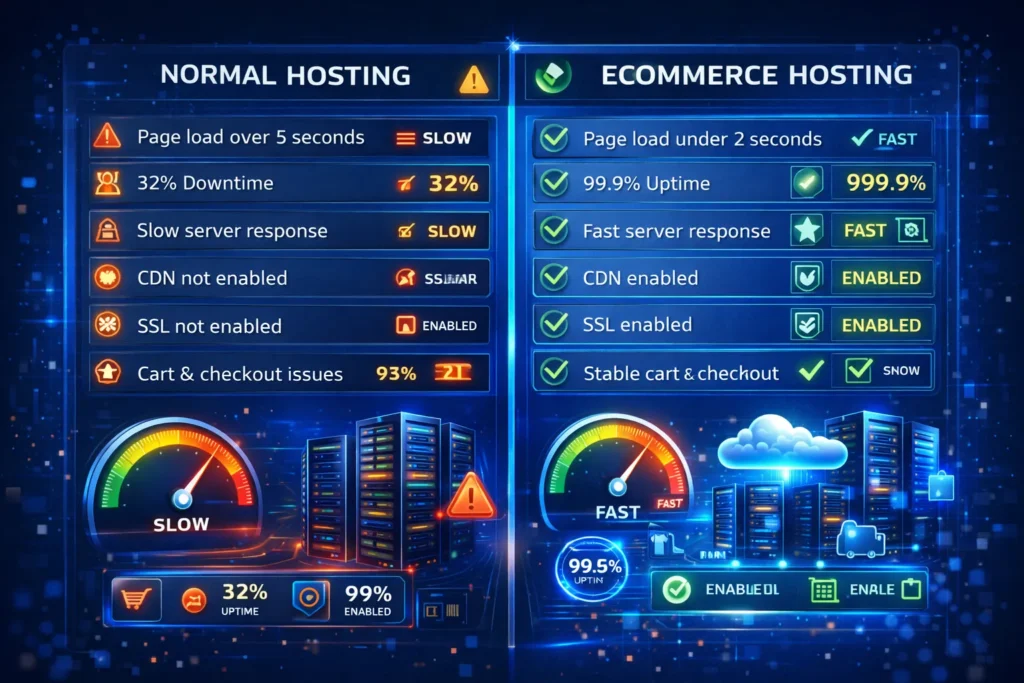
Normal hosting:
- Shared resources
- Slow database
- No ecommerce tuning
- Weak session handling
Ecommerce hosting:
- Performance tuned
- Secure transactions
- Cart stability
- Scalable resources
- Conversion-focused
Real Solutions to Fix Ecommerce Hosting Issues
Upgrade to Managed Ecommerce
Managed hosting handles:
- Performance tuning
- Security updates
- Server optimization
- Monitoring
Use Performance Stack
Recommended stack:
- LiteSpeed
- Redis cache
- CDN
- Image compression
- Query optimization
Optimize Database
Large stores need:
- Query indexing
- DB cleanup
- Cache layer
Add Edge Caching
Edge caching speeds global users.
Monitor Performance
Use tools:
- GTmetrix
- PageSpeed Insights
- Server logs
- Uptime monitors
How to Choose the Best Ecommerce Web Hosting Provider
Ask these questions:
- Do they specialize in ecommerce?
- Do they support your platform?
- Do they provide performance tuning?
- Is checkout stability guaranteed?
- Do they include CDN?
- Do they offer scaling?
- Is security managed?
Never choose hosting based only on price.
Choose based on performance.
Who Needs Strong Ecommerce Most?
- High traffic stores
- Ad-driven stores
- Flash sale stores
- Large product catalogs
- International stores
- Mobile-heavy stores
Final Thoughts
Ecommerce hosting is not just backend infrastructure. It is your revenue engine.
Better ecommerce Web hosting improves:
- Speed
- UX
- Trust
- CTA response
- Checkout reliability
- Conversion rates
If your store is slow or unstable, fix hosting first before changing design or ads.
Best ecommerce hosting = better user experience + higher sales.
Faqs
Ecommerce hosting is specialized web hosting designed for online stores. It supports fast performance, secure transactions, stable checkout, and traffic spikes for better shopping experiences
Ecommerce is important because it affects speed, uptime, checkout reliability, and security. These factors directly influence customer trust and conversion rates.
Yes. Ecommerce Web hosting is optimized for cart systems, payment gateways, databases, and high traffic. Normal hosting lacks this performance tuning.
Yes. Faster ecommerce hosting improves page speed and checkout response times, increasing user satisfaction and conversions.
Performance optimization and scalability are top features. They ensure your store stays fast even during traffic spikes.
Yes. Slow or unstable hosting causes checkout errors and delays, which leads to cart abandonment.
Use tools like GTmetrix, PageSpeed Insights, and uptime monitors to measure speed, response time, and reliability.